Sharing the Road
01 / 04
Bicyclists
Bicyclists have the same rights, duties and responsibilities as drivers. Bicycles are small and easy to miss, and a rider who is hit is often seriously injured or killed, so the law asks more of drivers.
Basic rules
- At intersections, yield to bicyclists as you would to a vehicle. When turning or pulling into a driveway, watch for bicyclists in the crosswalk or on the sidewalk.
- Bicyclists in a crosswalk count as pedestrians. Yield to them in marked and unmarked crosswalks alike.
- You cannot share a lane with a bicyclist. Bicyclists may legally use the full lane and ride where they are most visible. Leave at least 3 feet when following one.
Passing a bicyclist
- Pass only when it is safe for you and for the rider.
- With two lanes in your direction, move over a full lane; with one lane each way, wait until there is no oncoming traffic. Leave at least 3 feet between the rider and the widest part of your vehicle. The rider may swerve at any moment to avoid a pothole you cannot see.
- Never cross into oncoming traffic to pass a bicyclist, and never pass on the right.
- Return to your lane only when fully clear. Moving back too soon squeezes the rider off the road.
- Do not pass a bicyclist just before a right turn. Let them clear the intersection first. Check over your right shoulder before every right turn; this is the cause of "right hook" crashes.
Bike lanes: green pavement, a solid white line and bicycle symbols. Even where the markings break, drive as if they continue. Enter a bike lane only to turn or to cross it to park at the curb. After parking, look in every direction for bicyclists before opening your door.
Sharrows: a bicycle with two chevrons painted in the lane means cars and bikes share it. Slow down and leave 3 feet when passing.
Check your understanding
Question 1 of 5
Passing a bicyclist on a road with one lane in your direction, how much space must you leave at minimum?
02 / 04
Motorcyclists
Motorcyclists follow the same traffic laws, but they are small, vulnerable and hard to see. Make scanning for motorcycles a habit.
- Following: leave more room behind a motorcycle than behind a car, and more again in rain or on slick pavement. Motorcycles stop faster than you expect and can go down on slippery surfaces.
- Lanes: riders constantly shift position within the lane to see, to be seen and to avoid debris. A motorcycle is entitled to the full lane width. Never move into the same lane beside a motorcyclist, even if the lane is wide and the rider is far to one side.
- Turning: motorcycles hide easily in blind zones. When turning right, look left, look right, then look left again, and check over your shoulder. Crashes where a driver pulls in front of a motorcycle or turns left across an oncoming one usually come from not seeing it or misjudging its speed.
- Road surface: gravel, debris, pavement seams, potholes, small animals and even manhole covers mean nothing to a car but can force a rider to slow or change position suddenly. Anticipate it.
- Lights: give riders plenty of time to see your turn signals and brake lights. In return, remember that a rider slowing down may roll off the throttle without braking, so no brake light shows, and some motorcycle turn signals do not cancel automatically. Stay especially alert beside a motorcycle.
Check your understanding
Question 1 of 5
The lane is wide and the motorcycle ahead rides to the right side. May you pass it on the left within the same lane?
03 / 04
Large Vehicles and Blind Zones
A blind zone is an area around your vehicle you cannot see from the driver's seat. It can completely hide a car, a motorcycle or a bicyclist. Adjusting your mirrors shrinks blind zones but never removes them. Before every lane change, turn or merge, turn your head and look to confirm the zone is clear, keeping the wheel straight while you look. A blind-spot warning system is a help, not a substitute for looking.
Stay out of other drivers' blind zones too. Speed up or slow down so they can see you.
Trucks and buses have much larger blind zones on all four sides, sometimes called "no zones." Remember: if you cannot see the driver's mirrors, the driver cannot see you.
Around large vehicles:
- Drop back when following so you can see the road ahead.
- Do not ride alongside for long.
- A loaded truck at 55 mph needs 450 feet to stop. Never cut in front of one, and merge ahead of it only once both its headlights show in your rearview mirror.
- Trucks may need more than one lane to turn and two lanes in a roundabout. Never pass a truck while it is turning.
- Keep away from vehicles with hazardous materials placards when you can.
- On long, steep grades trucks are slow. Expect slow vehicles in the right lane.
- Snowplows throw up clouds of snow; do not follow closely.
- An orange triangle on the back of a farm vehicle means it travels 25 mph or less. Be patient, and pass as you would a bicyclist: move over a full lane if you can, otherwise wait for a gap in oncoming traffic and leave 3 feet.
Check your understanding
Question 1 of 5
Before changing lanes, besides checking your mirrors, what must you do?
04 / 04
Trains and Light Rail
Trains always have the right-of-way. They are heavy and cannot stop quickly even at low speed; a full stop can take up to a mile.
- Cross tracks only at designated crossings. Watch for signs, flashing lights and gates.
- When the red lights flash and the bells ring you must stop, whether or not the gate is down. Never drive around a gate.
- Stop 15 to 50 feet from the nearest rail when: the signal is flashing; the gate is lowering or down; a flagger signals you to stop; a train is close enough to be an immediate hazard; you hear a train horn; or a stop sign is posted.
- Go only when the red lights stop flashing and every other warning has cleared.
Three iron rules
- Do not try to beat a train. The moment the warnings activate, stop.
- Do not stop on the tracks. In backed-up traffic, make sure there is room for your whole vehicle on the far side before crossing. If your vehicle stalls or gets stuck on a crossing, get everyone out immediately, move away from the tracks, then call for help.
- Do not ignore the warning signals. Trust them even if you see no train. Trains are closer, quieter and faster than they look, and can come from either direction on any track.
If anything is on or near the tracks, call the number on the blue and white Emergency Notification System sign at the crossing and give the crossing ID number. If there is no sign, call 911.
Light rail: Sound Transit's Link light rail crosses and runs beside roads in the Seattle area. Obey all signs and markings, watch for approaching trains, leave at least one car length between you and a train, and never stop, park or leave your car on the tracks.
Check your understanding
Question 1 of 5
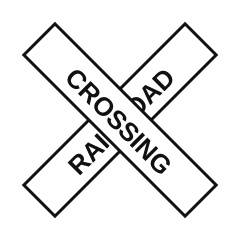
At a railroad crossing the red lights flash and bells ring, but the gate is up and you see no train. You should: