Right-of-Way
01 / 04
Yielding at Intersections
At an intersection with no signals or signs, the first vehicle to arrive goes first. If two vehicles arrive at the same time, the vehicle on the right goes first.
At a STOP sign you must come to a complete stop and proceed only when it is safe. At a four-way stop the same rules apply: first to arrive goes first, and on a tie the vehicle on the right goes first.
When turning left you must yield to oncoming traffic going straight or turning right. These rules about who goes first are called the right-of-way.
An intersection is any place where two or more roads meet: cross streets, T-junctions, driveways and parking lot entrances all count. Every intersection is legally a crosswalk, marked or not. Before you enter one:
- Yield to vehicles and pedestrians already in the intersection, look in each direction more than once, and check over your shoulder for bicyclists and motorcyclists.
- If your view of cross traffic is blocked at the stop line, edge forward slowly until you can see. Crossing drivers see the front of your car first and have a chance to slow down.
- Make sure there is room on the far side so you do not stop in the middle and block cross traffic.
How the right-of-way works under different controls:
- Four-way stop: first to arrive goes first; on a tie, yield to the right; a vehicle turning left yields to vehicles going straight or turning right.
- Two-way stop: the side with the stop signs yields to through traffic on the uncontrolled road. Turning vehicles yield to vehicles going straight.
- Uncontrolled intersection (no signs at all, common on residential streets): you must yield when a vehicle is already in the intersection, when you enter or cross a state highway from a secondary road, when you enter a paved road from an unpaved road, or when you are turning left and a vehicle is approaching from the opposite direction.
- T- and Y-intersections: traffic from the road that ends or the minor road yields to traffic on the through road.
The right-of-way is something you give, never something you take. Even when it is yours, if the other driver does not yield, the safe choice is to stop.
Check your understanding
Question 1 of 5
Two vehicles arrive at an uncontrolled intersection at the same time. Who goes first?
02 / 04
Pedestrians First
Pedestrians in a crosswalk always have the right-of-way, whether the crosswalk is marked or not. Every intersection is an unmarked crosswalk.
When a pedestrian is about to cross, you must stop and let them go, not slow down and steer around them. Near schools and around blind pedestrians (white cane or guide dog) the duty to yield is even stricter.
Washington spells out what yielding to a pedestrian means:
- Wait until the pedestrian has cleared your lane and one additional lane before you proceed.
- If the pedestrian uses a wheelchair, cane, guide dog or other service animal, wait until they have completely crossed the street. Do not honk; it can frighten or confuse the animal and the person.
- Never drive into oncoming traffic to get around a pedestrian or bicyclist.
- Stop for people in a marked mid-block crosswalk too, whether or not there is a stop sign.
Watch especially for people who cannot see you, are distracted or may be confused: people stepping out from behind buildings or parked cars, people with their backs to you, people with hats or umbrellas, children, delivery workers, road crews, people on their phones or wearing headphones, and tourists following a map.
Check your understanding
Question 1 of 5
A pedestrian is about to cross at an unmarked intersection. You should:
03 / 04
Emergency Vehicles and School Buses
When an emergency vehicle (police, ambulance, fire truck) approaches with lights or siren, pull to the right and stop until it has passed.
When a school bus extends its stop sign and flashes red lights, traffic in both directions must stop, unless the roadway is divided by a physical median.
Emergency vehicles: fire trucks, ambulances and police cars using lights or sirens always have the right-of-way. As soon as you see or hear them, pull to the right side of the road and stop. Wait until they have passed before signaling and reentering traffic in the order you were traveling.
Emergency zones (the Move Over law): when a roadside response vehicle has its lights flashing, including tow trucks, incident response, highway maintenance, utility vehicles and law enforcement, you must either:
- move over into a lane farther away, or
- if you cannot, slow down to at least 10 mph below the posted limit, and never faster than 50 mph through the zone.
School buses: bus lights work like traffic signals. Flashing yellow means the bus is about to stop; flashing red with the stop sign extended means you must stop.
- All vehicles traveling in the same direction as the bus must stop, including vehicles in the center turn lane and other turn lanes.
- Oncoming vehicles must also stop on a two-lane road. Only when the road has three or more lanes, or is divided by a median or barrier, may oncoming traffic continue.
- Go only after the red lights stop flashing, the sign is retracted and the arm returns to the front bumper. Keep watching for children afterwards.
- Fines double for passing a stopped school bus.
Check your understanding
Question 1 of 5
An ambulance with lights and siren approaches from behind. You should:
04 / 04
Roundabouts and Special Intersections
A roundabout is a circular intersection with a raised center island. Every vehicle yields on entry and then travels counterclockwise. To drive one:
- Slow down as you approach. Roundabouts are designed for 15 to 25 mph.
- Read the lane choice sign and pick your lane early for a right turn, straight through or left turn. Once in, stay in that lane until you exit.
- Stop for pedestrians and bicyclists in the crosswalks both entering and exiting.
- Look left and yield to all traffic already in the roundabout; it has the right-of-way. Enter when you see a gap.
- Enter to the right, travel counterclockwise and exit at the street you want.
- Trucks and buses may ride over the truck apron around the center island and use both lanes. Give them plenty of room and do not drive beside them.
- If an emergency vehicle approaches while you are in the roundabout, drive through and pull over after you exit. Do not stop inside.
A traffic calming circle is a small painted or raised island in the middle of a residential intersection. It may have stop or yield signs on all, some or none of its approaches; apply the normal right-of-way rules. Large vehicles such as fire trucks may need to go clockwise around it.
A diverging diamond is a newer freeway interchange design in Washington. Markings and signals guide you to cross temporarily to the left side of the road so left turns onto and off the freeway no longer conflict with oncoming traffic; after the overpass or underpass you cross back to the right. Follow the markings and signals and you cannot go wrong.
Check your understanding
Question 1 of 5
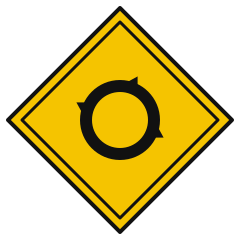
Before entering a roundabout, whom must you yield to?