Traffic Signs and Signals
01 / 04
Regulatory Signs
A sign's color and shape tell you its meaning before you can read the words. Red means stop, yield or prohibited; white is a regulation; yellow is a warning; orange is a work zone; green gives directions; blue marks services; brown marks parks and attractions; fluorescent yellow-green warns of schools, pedestrians and bicycles.
Regulatory signs tell you what you must do or must not do. Ignoring one is a violation.
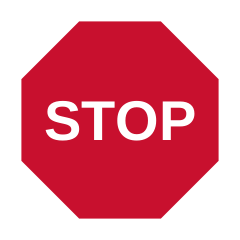 STOP: a red octagon, the only sign with this shape. Come to a complete stop at the stop line; if there is none, stop before the crosswalk; if there is neither, stop at the corner. Look in every direction and yield to vehicles and pedestrians that have the right-of-way.
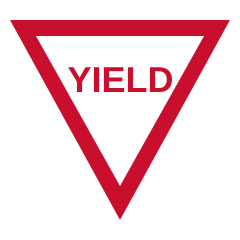 YIELD: a red and white downward triangle. Slow down, stop if needed, and let traffic and pedestrians already moving through go first.
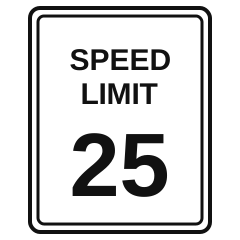 Speed limit: a white rectangle with black numbers showing the maximum speed under ideal conditions. Some highways also post a minimum speed; driving slower than that is also a violation.
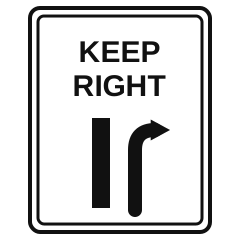 KEEP RIGHT: stay in the right lane except to pass.
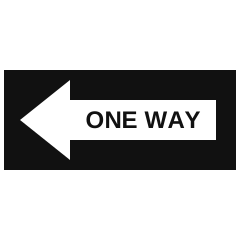 ONE WAY: traffic flows only in the direction of the arrow. Never drive the wrong way on a one-way street.
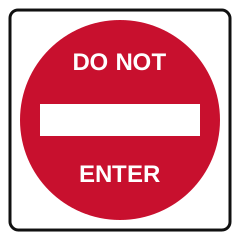 DO NOT ENTER: a square sign with a white bar inside a red circle. You may not enter the road from this direction.
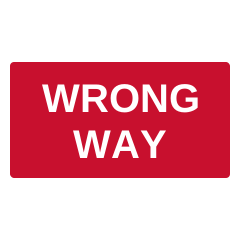 WRONG WAY: a red rectangle with white letters telling you that you are already going the wrong direction. Stop and turn around immediately.
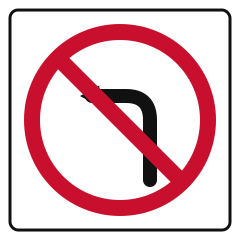 Prohibition signs: a red circle with a slash over a symbol means that action is not allowed, such as no left turn, no right turn or no U-turn.
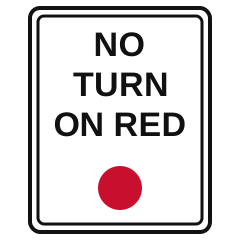 NO TURN ON RED: posted next to a signal. When you see it, you may not turn right on a red light.
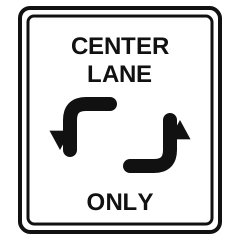 Shared center turn lane: the middle lane with yellow lines on both sides is only for left turns from either direction. Do not use it to drive through or to pass.
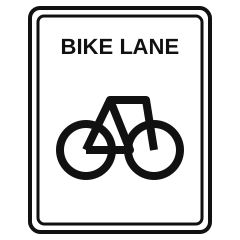 BIKE LANE: a white sign with a bicycle symbol marking a lane reserved for bicycles. Cars may enter it only to turn or to cross to a curb parking space.
- Automated traffic safety cameras: they record you running a steady red light, failing to stop at a railroad crossing signal, or speeding in a school zone. Camera locations are clearly marked, and tickets are mailed to the vehicle owner.
Check your understanding
Question 1 of 5
What does a red octagon sign mean?
02 / 04
Warning Signs
Most warning signs are yellow diamonds with black symbols. They alert you to a hazard or a change in road conditions ahead. Slow down early and be ready to act.
Common warning signs include: curve, winding road, slippery when wet, signal ahead, stop ahead, merge, lane ends, narrow road or bridge, two-way traffic, hill, soft shoulder, low clearance, deer crossing and circular intersection ahead.
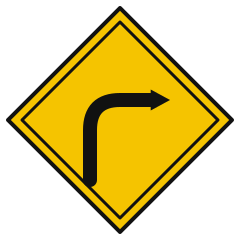
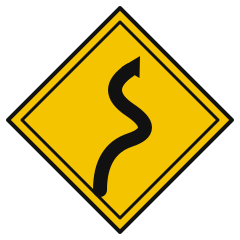
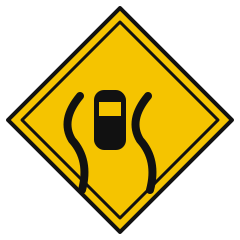
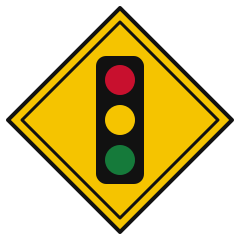
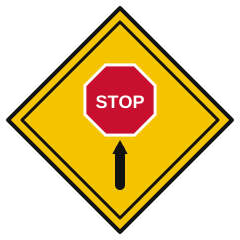
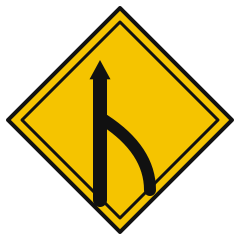
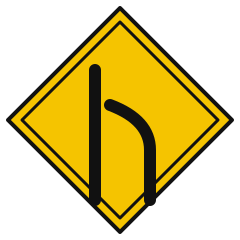
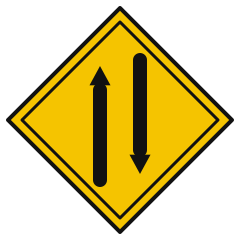
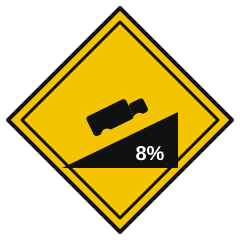
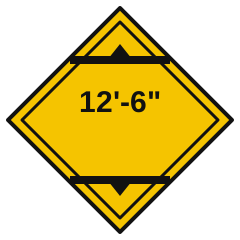
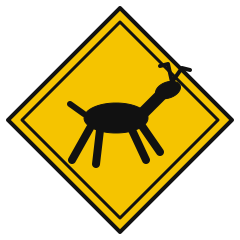
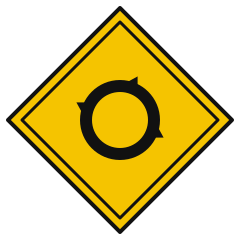
A few special warning signs are worth knowing on sight:
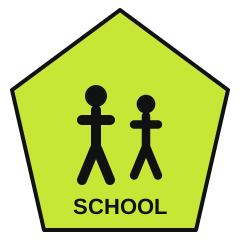 Fluorescent yellow-green: school, pedestrian or bicycle activity ahead. A pentagon is a school sign; a walking figure warns of a pedestrian crossing.
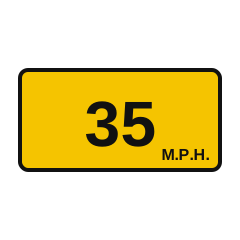 Advisory speed plate: a small yellow plate with black numbers under a curve sign, such as "35". It is a recommended safe speed, not a limit, and in rain or snow you should go slower still.
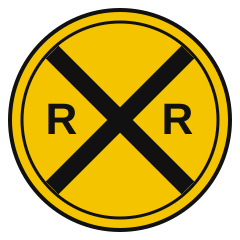 Railroad advance warning: a round yellow sign with a black X and the letters RR means a railroad crossing is ahead. The crossing itself has a white X-shaped crossbuck.
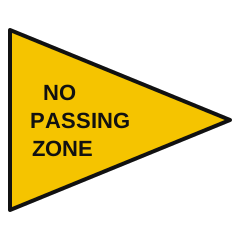 No passing zone: a yellow pennant on the right side of the road, pointed end forward, marks where passing is not allowed.
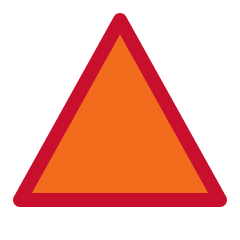 Slow-moving vehicle: an orange triangle on the back of tractors, horse-drawn wagons and similar vehicles means it travels at 25 mph or less.
- Variable speed limit and advance notification signs: digital freeway signs change the speed limit with traffic, close lanes ahead of time and warn of slow traffic. The posted variable limit is enforceable.
Check your understanding
Question 1 of 5
Yellow diamond-shaped signs are:
03 / 04
Work Zone, Guide and Service Signs
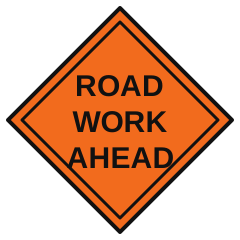
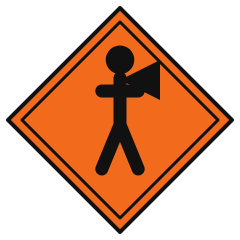

Orange belongs to work zones. Construction, maintenance and emergency operation signs, cones and barrels tell you people are working on or near the road.
- Inside a work zone, drivers, pedestrians and bicyclists must yield to workers, to vehicles with flashing yellow lights, and to equipment.
- Fines double for violations committed in a work zone when workers are present.
- Reduce your speed even when you see no workers. Narrow lanes and rough pavement are hazards by themselves.
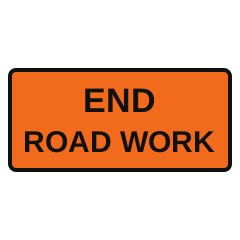
- Follow the work zone signs until you see the END ROAD WORK sign.
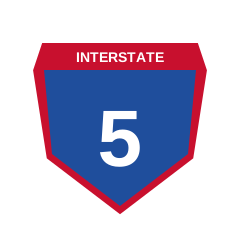
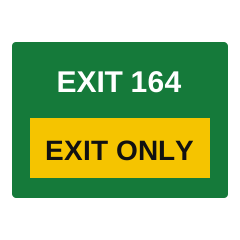
Green signs guide you: destinations, distances, exit numbers and city mileage. The shape and color of a route marker tell you the kind of road. Interstates use a red, white and blue shield, U.S. routes a white shield, and Washington state routes an outline of George Washington's head. A lane marked EXIT ONLY must leave the freeway; a lane without those words may exit or continue.
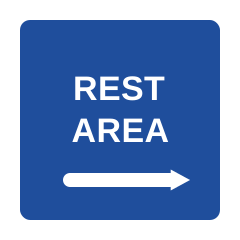
Blue signs mark motorist services: hospitals, gas, electric vehicle charging, rest areas, lodging and food.
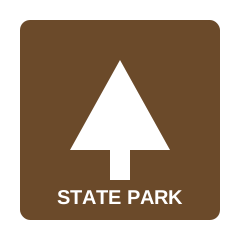
Brown signs mark recreation and culture: state parks, trails, picnic areas, ski areas and historic sites.
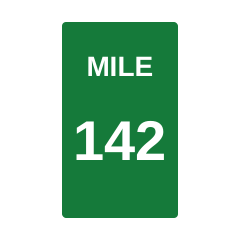
Small green mile markers count up from the western or southern end of each highway. When you call for help, giving the route number and the nearest mile marker lets responders find you.
Check your understanding
Question 1 of 5
Orange diamond-shaped signs indicate:
04 / 04
Traffic Signals
- Solid red: stop. Come to a complete stop at the stop line and wait until the light turns green and the intersection is clear of vehicles and pedestrians. After a full stop, you may turn right on red if there is no "No Turn on Red" sign and there is plenty of room. You may also turn left on red from a one-way street onto another one-way street after stopping.
- Flashing red: works like a stop sign. Come to a full stop and go when it is your turn.
- Red arrow: you may not go in the direction of the arrow. Wait for it to turn green.
- Solid yellow: the light is about to turn red. Slow down and prepare to stop; never speed up to beat it. If you are already in the intersection when it turns yellow, continue through at the posted speed.
- Flashing yellow: works like a yield sign. Slow down and follow the right-of-way rules for an uncontrolled intersection.
- Yellow arrow: the turn signal is about to turn red. Prepare to stop and give the right-of-way to oncoming traffic.
- Solid green: go, but first wait for the intersection to clear and yield to pedestrians and emergency vehicles.
- Green arrow: you may turn in the direction of the arrow. Oncoming and crossing traffic are stopped by red lights, so this is a protected turn.
- Flashing yellow arrow: you may turn, but oncoming traffic is moving. Yield to oncoming vehicles and pedestrians before you turn.
- Freeway ramp meters: the signal at a freeway on-ramp works like any other. Stop at the white stop line on red and enter the ramp on green, usually one vehicle per green.
- Dark or broken signal: treat the intersection as a four-way stop. Stop, then go in the order you arrived.
Washington has no flashing green lights. If you see one in British Columbia, Canada, it warns that pedestrians are waiting to cross.
Check your understanding
Question 1 of 5
At a red light with no "No Turn on Red" sign, you may: