Lanes and Turning
01 / 04
What Lane Lines Mean
Lines, arrows and words painted on the road carry the same legal weight as signs. Two rules cover most of it: yellow separates opposing traffic, white separates traffic going the same way; dashed lines may be crossed, solid lines should not be, and double solid lines must not be.
White lines
- Dashed white line: separates lanes going the same direction. You may cross it to change lanes when safe.
- Short, closely spaced dashed white line: the lane is ending. You will need to merge or exit.
- Solid white line: marks the edge of the road or a bike lane, or tells you to stay in your lane unless a special situation requires a change.
- Double solid white line: a barrier between lanes. Crossing it is illegal.
Yellow lines
- Dashed yellow line: the center of a two-way, two-lane road. You may use the oncoming lane to pass when safe.
- Solid yellow line: the left edge of the road or a no-passing zone. Do not cross it to pass.
- Double solid yellow centerline: the middle of a two-way road. No passing in either direction.
- Solid yellow beside dashed yellow: if the solid line is on your side you may not pass; if the dashed line is on your side you may pass when safe.
- Median: open ground, a concrete divider, or an 18-inch striped solid yellow area. Driving within, over or across a median is illegal.
Other markings
- Stop line: the thick white line at a stop sign or signal. Stop before your vehicle reaches it; if there is none, stop before the crosswalk.
- Crosswalk: some have in-pavement lights that flash when a pedestrian crosses, and you must yield while they flash. Every unmarked intersection is a crosswalk too.
- Bike lane: a solid white line with bicycle symbols. A buffer of two white lines with diagonal hatching is part of the bike lane; enter it only to make a legal turn after checking that it is safe.
- Sharrows: a bicycle with two chevrons painted in the lane means cars and bikes share it. Give bicyclists at least 3 feet when passing.
- Bicycle box: a green box ahead of the stop line at an intersection. Bicyclists go first on green. You may not turn right on red at a bicycle box; stay behind the white line until it is clear.
- Fire lane: red stripes or a red curb. No stopping or parking.
- Yellow striped areas: places where you may not drive.
If the road has no markings at all, keep as far right as is safe.
Check your understanding
Question 1 of 5
The centerline is a double solid yellow line. What does it mean?
02 / 04
HOV, Reversible and Reserved Lanes
HOV lane (carpool lane): marked with a diamond on signs and pavement and separated by a solid white line. They are for vehicles meeting the posted occupancy, vanpools and buses; motorcycles may also use them. A carpool lane is not a passing lane.
Express toll lanes: free for buses, vanpools, carpools and motorcycles, and solo drivers may pay a toll to use them. A Good To Go! account is the cheapest way to pay tolls in Washington.
Reversible lanes: such as Seattle's express lanes, switch direction on a schedule to match commute traffic and are usually marked by double dashed white lines. Check the overhead lane signals before entering:
- Green arrow: you may use the lane.
- Red X: you may not.
- Steady yellow X: the lane is about to change direction; move out as soon as it is safe.
Reserved lanes: signs or markings reserve them for special uses, such as transit-only lanes.
Shared center turn lane: the middle lane with yellow lines on both sides is for left turns into and out of the road from either direction, and for U-turns where permitted. You may cross the solid yellow line on your side to enter it, but watch for oncoming drivers using the same lane. Never use it to pass or travel through, and do not drive in it for more than 300 feet.
Turn lanes: once you are in a turn lane you must complete the turn; you may not go straight instead.
Check your understanding
Question 1 of 5
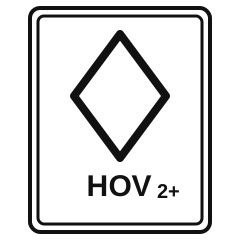
A diamond symbol on signs and the pavement marks what kind of lane?
03 / 04
Lane Changes, Merging and the Zipper Merge
General rules
- Drive on the right, and keep right except to pass. Use the left lane to pass slower traffic, and obey the speed limit even while passing.
- Do not pass or drive on the shoulder unless signs or officials direct you to.
- Do not stop in a travel lane. If you must stop, keep moving until you can pull over safely.
- Never back up on the road, even if you miss a turn or exit. Backing on a shoulder or freeway is illegal.
- Police, construction and maintenance workers, and school crossing guards directing traffic overrule signals. Follow their directions.
How to change lanes: check your mirrors, signal, look over your shoulder at your blind zone, confirm a gap large enough that no one has to brake or swerve, move over smoothly, and cancel your signal.
Merging onto a freeway: traffic already on the freeway has the right-of-way. Use the whole on-ramp to match the speed of traffic, signal, check mirrors and merge into a safe gap. If the gap is too small, adjust your speed rather than forcing your way in.
Zipper merging: when a lane closes ahead and traffic is slow or stopped, do not line up early in one lane. Instead:
- Stay in your lane and use both lanes up to the merge point.
- Take turns, alternating with the other lane like the teeth of a zipper.
- Be courteous: let one vehicle from the ending lane in ahead of you, then take your turn.
- Maintain speed, matching the open lane and merging smoothly.
Zipper merging improves traffic flow by about 60 percent, creates a predictable pattern, and removes the frustration of line-cutting.
Check your understanding
Question 1 of 5
When you merge onto a freeway from an on-ramp, who has the right-of-way?
04 / 04
Turns and U-Turns
Before the turn
- Signal at least 100 feet before turning.
- Get into the correct lane early: the rightmost lane for a right turn, the lane nearest the centerline for a left turn.
- Check the road you are turning onto for vehicles, pedestrians and bicyclists, and look behind you for bicyclists and yield to them. They approach faster than you expect.
During the turn
- State law requires you to turn into the lane closest to you: the rightmost lane on a right turn, the lane next to the centerline on a left turn. Change lanes afterward if you need to.
- With more than one turn lane, stay in your lane all the way through; do not drift into the next lane mid-turn.
- Turning left from a one-way street onto another one-way street, go from the leftmost lane into the leftmost lane.
- Yield to oncoming traffic going straight or turning right when you turn left; yield to pedestrians in the crosswalk when you turn right.
U-turns
- U-turns are generally allowed in Washington unless a sign prohibits them.
- You must have clear visibility in all directions, with approaching traffic able to see you within 500 feet. That is why you may not make a U-turn on a curve or near the crest of a hill.
- Do not make a U-turn where a sign prohibits it, on a one-way street, or across a median.
- Yield to all approaching traffic and pedestrians, and turn only when no one will have to slow down or swerve.
Hand signals: if your turn signals fail, use your left arm. Arm straight out means left turn, arm bent upward means right turn, arm pointed down means slowing or stopping.
Check your understanding
Question 1 of 5
How far before a turn must you signal, at minimum?